Monica Sand
artist and producer of Acting Physics
Monica Sand has worked with giving artistic interpretation of physics research. To be able to do that she has cooperated with scientists at CERN (Geneva) Chalmers Technical Highschool at Göteborg and at the universities of Stockholm and Linköping. In her art she uses materials specially made for experiments in particle physics. She also uses results from research and studies the working process compared to the artistic process. The artistic result has been several exhibitions and sculptures which show interpretation of physics.
Monicas website
I draw a place with high columns like sky-scrapers, a Manhattan, dark tall dense.
I start from diagrams of how much energy, or light, a particle deposits in the detector. This is not really related to the energy of the particles, but rather how they traverse the detector. They can enter bang in the middle of the detector, sneak by close to the edge, traverse at an inclination or straight through. This all give different responses from the detector.
To visualise how the energy is distributed I have built the sculpture as five groups in an imagined bar chart representing pulse-heights deposited by the muons in the detectors.
It is very important that the observer should know (or has the possibility of knowing) that the tower which lights up is the tower which has been "hit" by a cosmic ray, and that the light comes on at a level which corresponds to the energy deposited in the detector. That is why the detector is inside the tower. One in each tower.
The cirkel of glass leads the observer along the glass wall with words. It is a book of glass with the background or the text sandblasted: the language is brittle and beautiful, a hindrance and simultaneously a means to understanding what we see. The path round the sculpture is a picture of scientific research: you can never directly observe what you investigate. Everything depends on the viewpoint of the observer.
The room is filled by sounds from the materials in the towers - glass and metal. A musical state where the sounds follow a similar time structure to that of the cosmic rays. Sometimes the sounds come one by one, and sometimes in cascades of sounds, based on the same mathematical perspective as the time distribution of the muons - the poisson distribution.
Around and around the observer can move in a path which leads to the conclusion which is the end of the poem, which is penetrated by the particles, strengthened by the music and demonstrated by the random, but mathematical play of light; this is not a world you leave.
photo: Monica Sand from Muon spin
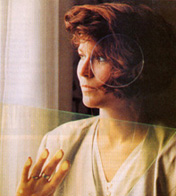
photo: Pressens Bild
TORN
The workingprocess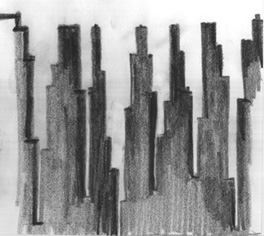
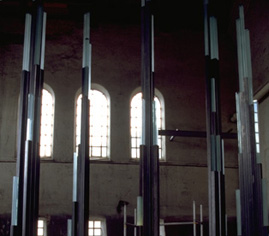
I call each group of bars a tower. Two of the towers are direct images of the poisson distribution. The towers are made of quadratic iron tubes of different heights with two glass plates on top.
There is one detector below each tower registering the cosmic rays. The signal generated by a particle is used to light up some of the glass plates with a lamp at the bottom of each tube. The light comes on for a short while and then decays slowly. The amount of energy deposited by the particle determines which of the lamps are lit up.
For low pulse-heights the lamps in the lower tubes light up for a rather short time. The larger the pulses the higher up the lamps light up and the slower the light decays.
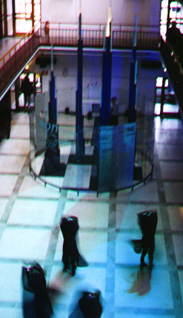
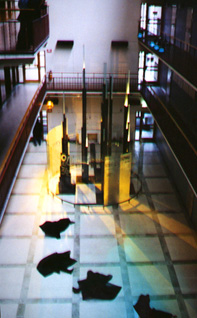
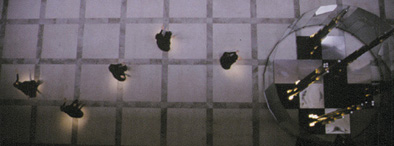
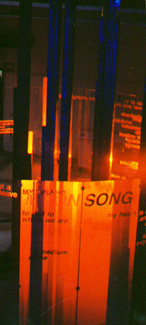
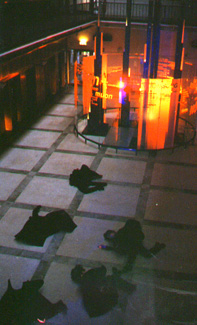
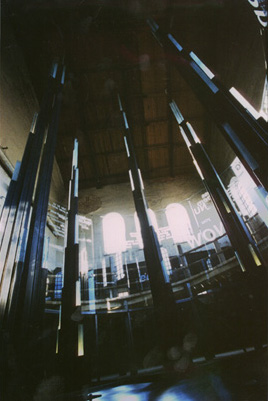
photo Yngve FranssonPhotograph Yngve Fransson from the Capital of Culture in Stockholm 1998
photo 1
photo 2
photo 3
photo 4
photo 5


