Physics
Muons from the cosmic rays turn on the lamps in the sculpture
Cosmic Rays
It takes 45 million years for a particle which travels at the speed of light from the galaxy NGC4261 to reach the Earth. In the centre of NGC4261 there is a very massive "black hole" which is swallowing part of the galaxy. There, at the edge of the black hole we believe that atomic nucleus are accelerated to enormous energies end beam out into space. After 45 million years perhaps one of these nuclei falls into the Earth atthe speed of light and interacts with a nucleus in the atmosphere. The enormous energy of the particle is partly transferred over to matter (following Einstein's famous for-mula E=mc2 giving a great number of new particles spraying the surface of the Earth.
The majority of the cosmic ray particles probably start their voyage towards the Earth from sources in our own galaxy, The Milky Way, e.g. from exploding stars (supernovae).
Our bodies are continuously penetrated by particles created in the collisions between the "extra terrestrial" particles and the atmosphere. In order to escape this radiation it is necessary to be many kilometres below the surface of the Earth. The particles reaching us are mainly muons which can be described as "heavy electrons". After some time the muons decay into electrons and neutrinos.
It is faschinating to think that each time the lamps are switched on in the sculpture a cosmic particle has finished its long journey through space from some very distant place.
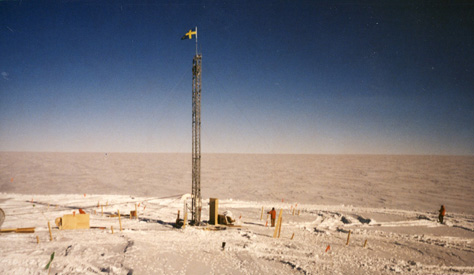
One scientific project which is searching for the secrets of the origin of the cosmic rays is the German-Swedish-American Amanda project in Antarctica. At the centre of Antarctica at the South Pole, scientists are building a new type of telescope which hopefully will teach us more about the Universe.
The neutrino particles which are interacting in the ice might have been on their way for millions of years before they collide in the glacier. Innumerable neutrinos are passing through all matter on Earth without being absorbed, but sometime they interac in the ice. When that happens a bluish flash of light is emitted in the interaction.
Amanda is not only looking for the origin of the cosmic rays, but is also searching for the answer of the "missing matter" question in the Universe, the so-called "dark matter" which seems to correspond to more than 90percent of the mass of the Universe. . Amanda is opening a new "window" to study the Universe!
Professor P-O Hulth, Fysikum, Stockholm University
|